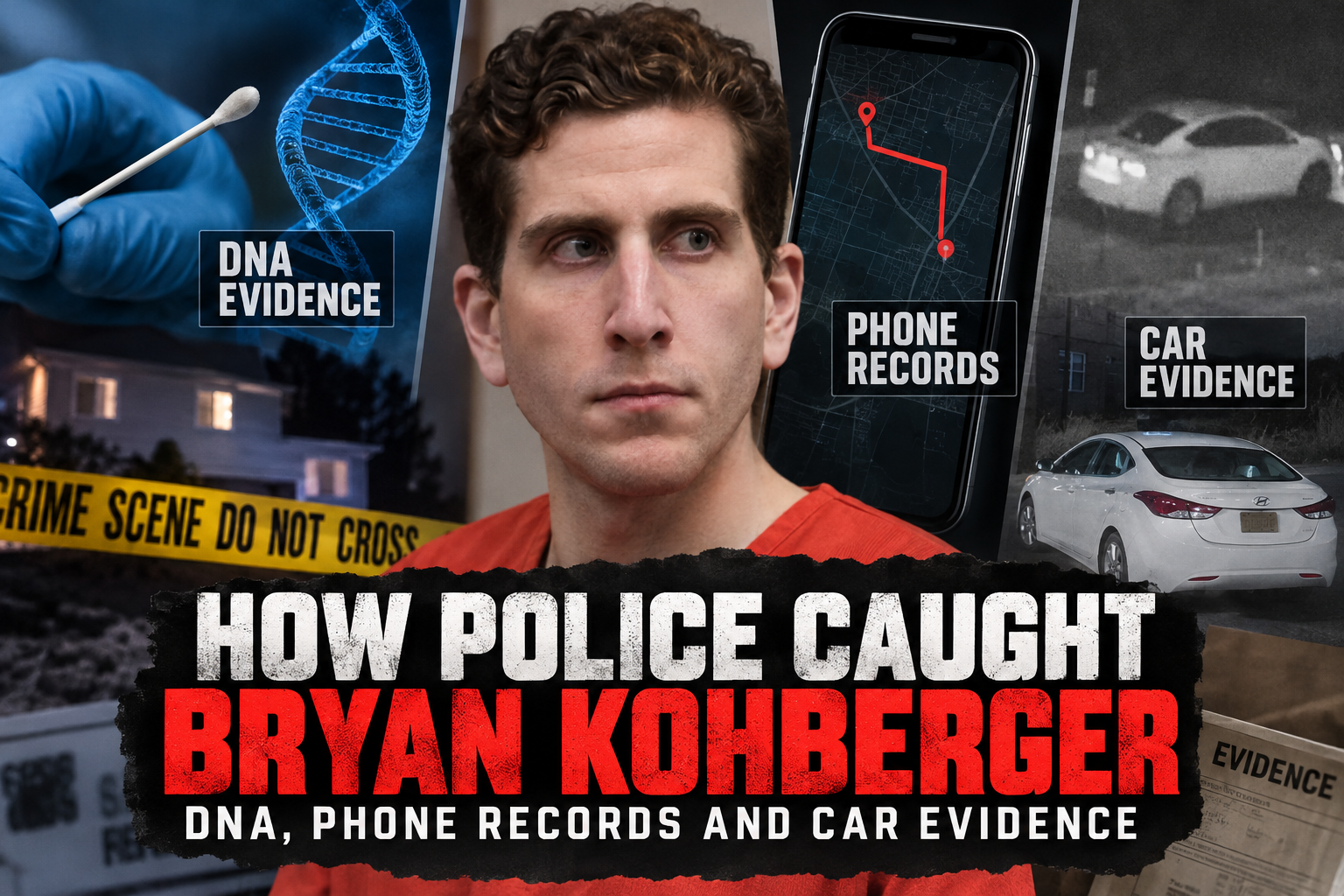
How did police catch Bryan Kohberger in the murders of four University of Idaho students? The investigation relied on a combination of forensic DNA analysis, investigative genetic genealogy, cellphone records, surveillance footage, and evidence connecting Kohberger to a white Hyundai Elantra.
The killings took place on November 13, 2022, at a residence on King Road in Moscow, Idaho. The victims were Madison Mogen, Kaylee Goncalves, Xana Kernodle, and Ethan Chapin. Investigators spent weeks reconstructing the events surrounding the murders before arresting Kohberger in Pennsylvania on December 30, 2022.
One of the most significant discoveries was a knife sheath recovered at the crime scene that contained male DNA. Investigators later used a genetic genealogy lead to narrow their search, examined DNA from trash collected outside Kohberger’s family home, and obtained a direct DNA comparison after identifying him as a suspect.
Meanwhile, surveillance cameras recorded a white Hyundai Elantra near the victims’ residence, and cellphone records helped investigators examine movements consistent with the vehicle’s route.
This article explains the Bryan Kohberger DNA evidence, the role of family DNA comparison, the significance of his cellphone records, and how investigators connected the different pieces of evidence during the Idaho murders investigation.
How Did Police First Identify Bryan Kohberger as a Suspect?
Investigators did not identify Kohberger through a single clue. Instead, they developed several investigative leads and compared them with physical evidence collected from the crime scene.
The initial investigation focused on the four victims, the residence at 1122 King Road, witness accounts, and recordings from nearby security cameras.
As investigators reviewed the footage, they noticed a white sedan repeatedly traveling near the house during the early morning hours of November 13, 2022. An FBI examiner subsequently identified the vehicle as potentially belonging to the Hyundai Elantra model range.
At the same time, forensic investigators were examining a knife sheath found inside the residence. DNA recovered from the sheath provided another important lead.
Investigators eventually identified a white 2015 Hyundai Elantra registered to Kohberger, who was studying criminal justice and criminology at Washington State University in Pullman, Washington.
His vehicle, physical description, cellphone records, and the developing DNA investigation helped authorities focus on him.
According to the probable-cause affidavit released in January 2023, investigators had assembled these leads before obtaining the arrest warrant.
Source: Idaho Statesman — DNA evidence, cellphone records and vehicle evidence.
1. The Knife Sheath DNA Evidence
One of the most important pieces of evidence was a tan leather knife sheath recovered near Madison Mogen’s body.
The sheath carried Ka-Bar branding and markings associated with the United States Marine Corps. Investigators reported that they recovered male DNA from the sheath’s button snap.
This discovery gave forensic specialists a biological profile they could investigate and compare with DNA obtained from potential sources.
Why Was the Knife Sheath Important?
Investigators believed the sheath was associated with a knife used in the attack. However, the murder weapon itself was not recovered.
The DNA on the sheath’s button snap provided a potential link between the crime scene and an individual who had handled the item.
DNA evidence can be highly informative, but its significance depends on the sample, the circumstances in which it was deposited, and the methods used to compare it with reference samples.
Investigators therefore continued working to establish whose DNA was present and whether the results could be corroborated by other evidence.
What Did the DNA Test Show?
The Idaho State Police laboratory developed a traditional short tandem repeat, or STR, DNA profile from the material recovered from the sheath.
STR analysis examines specific regions of DNA that vary among individuals. Forensic laboratories can compare these profiles to assess whether biological material is consistent with a particular person.
Initially, investigators did not publicly identify the person associated with the DNA profile.
They subsequently used investigative genetic genealogy to develop a lead and conducted further DNA testing after Kohberger became a suspect.
The distinction is important: the original sheath sample supplied the forensic evidence, while subsequent investigative steps helped establish whose DNA was involved.
Source: CBS News — DNA found on the knife sheath.
2. How Family DNA Helped Police Identify Kohberger
The role of family DNA is among the most frequently searched aspects of the case. It is also important to understand that investigators used two different approaches: investigative genetic genealogy and a later conventional DNA comparison.
What Is Investigative Genetic Genealogy?
Investigative genetic genealogy, commonly abbreviated as IGG, uses genetic information and genealogical research to develop investigative leads.
In a criminal investigation, specialists may compare a suitable DNA profile with information available through genetic genealogy databases. Potential familial relationships can help investigators build family trees and narrow down possible identities.
This technique does not automatically establish that a particular person committed a crime. Instead, it can help investigators identify people who should be examined through other investigative methods.
How Was Genetic Genealogy Used in the Idaho Murders?
In June 2023, prosecutors confirmed in court filings that the FBI had used investigative genetic genealogy during the investigation.
According to the filings, the genealogy process helped direct investigators toward Kohberger as a person to investigate.
Prosecutors also clarified that the genealogy lead was not itself substantive evidence of guilt. The FBI had not simply taken the genealogy profile from the sheath and treated it as a direct match to Kohberger’s DNA.
Investigators continued gathering conventional forensic evidence to determine whether he was the source of the DNA recovered from the crime scene.
The DNA Collected From the Kohberger Family Home
On December 27, 2022, investigators collected trash from outside the home of Kohberger’s parents in Pennsylvania, where he was staying during the holidays.
The material was sent to the Idaho State Police laboratory for testing.
According to the probable-cause affidavit, the DNA profile obtained from the trash indicated that the biological father of the person associated with the knife-sheath DNA could not be excluded as the source of the paternal relationship.
The affidavit stated that at least 99.9998% of the male population would be expected to be excluded from the possibility of being the biological father of the person who left the DNA on the sheath.
This result helped investigators corroborate the developing identification.
It is important to understand what the statistic meant: it related to the probability of excluding unrelated men as the biological father under the reported analysis. It was not a statement that there was a 99.9998% probability that Kohberger was guilty.
The Direct DNA Comparison
After Kohberger was identified and arrested, investigators obtained a cheek swab from him under a search warrant.
Prosecutors later reported that conventional STR DNA analysis showed a statistical match between Kohberger’s reference sample and the DNA profile developed from the knife sheath.
This was distinct from the earlier genetic genealogy lead and the paternal comparison using material from his family’s trash.
Taken together, these steps show how investigators moved from a DNA profile of initially unknown origin to a direct forensic comparison with a named suspect.
Sources:
- Idaho Statesman — Prosecutors confirm the genetic genealogy process
- Idaho court filing — State’s motion discussing investigative genetic genealogy
3. The White Hyundai Elantra Evidence
Surveillance footage of a white Hyundai Elantra became another major investigative lead.
Police examined recordings from the neighborhood surrounding 1122 King Road and found a vehicle traveling near the residence during the estimated window of the killings.
The car appeared in multiple recordings, allowing investigators to compare its movements with footage from other locations.
Why Did Investigators Focus on This Car?
The vehicle’s repeated appearances near the residence attracted investigators’ attention. An FBI examiner initially assessed the vehicle as potentially being a 2011–2013 Hyundai Elantra, with the possible model range later broadened to include vehicles through 2016.
On November 25, 2022, investigators began seeking information about white Hyundai Elantras that might have been in the area.
A Washington State University police officer subsequently identified a white 2015 Hyundai Elantra registered to Kohberger.
The car was located near his student residence in Pullman, Washington, on November 29.
This identification gave investigators a named vehicle owner whose movements and other evidence could be examined.
What Did the Surveillance Footage Show?
According to the probable-cause affidavit, recordings showed a white sedan making several passes near the King Road residence before the killings.
The vehicle was recorded in the area during the early morning hours, including a pass at approximately 4:04 a.m. It was subsequently recorded leaving the neighborhood at approximately 4:20 a.m.
Investigators compared these recordings with other footage showing a vehicle traveling between Moscow and Pullman.
The recordings helped them reconstruct the car’s movements, but they did not provide a clear, continuous view of every event or independently prove the driver’s identity.
Why Did the Car’s Registration Matter?
Kohberger’s vehicle had been registered in Pennsylvania before the murders. Investigators learned that its registration had been changed to Washington state on November 18, 2022, five days after the killings.
That information helped them connect vehicle records with surveillance footage and the suspect’s known residence.
The registration change was one detail in the investigation, not independent proof of wrongdoing. Its importance came from how it fit with the other evidence.
Sources:
4. Bryan Kohberger’s Phone Records Explained
Cellphone records helped investigators examine Kohberger’s movements before, during, and after the murders.
Investigators obtained historical records associated with his phone and compared the available location information with surveillance footage and other evidence.
Phone Activity Before the Murders
According to the probable-cause affidavit, cellphone records indicated that Kohberger’s phone had used cellular resources serving the area around the King Road residence on at least 12 occasions before November 13, 2022.
Most of these occasions occurred during late evening or early morning hours.
Investigators considered these records relevant because they showed previous phone activity in the general area of the victims’ residence.
However, cellular records do not necessarily identify a phone’s exact location. A tower can serve a broader area, and a phone’s connection to a particular cellular resource does not prove that its owner visited a specific building.
Phone Activity During the Early Morning of November 13
Records showed the phone associated with Kohberger connecting to cellular resources before approximately 2:42 a.m. on the morning of the killings.
The phone then stopped reporting to the network until approximately 4:48 a.m.
Investigators considered this gap alongside the vehicle’s recorded movements and the estimated time of the murders.
The absence of network activity did not, by itself, prove that the phone had been switched off or establish the reason for the gap. It was one part of the timeline investigators were trying to reconstruct.
Phone Activity After the Murders
After the phone reconnected, its recorded activity was examined in relation to the movements investigators attributed to the white Hyundai Elantra.
Investigators also reviewed the phone’s historical records to establish whether it had previously been in the area around the victims’ residence.
The value of this evidence came from comparing it with other information, including vehicle sightings and forensic findings.
Cellphone records were not a standalone identification method. They helped investigators test whether the movements associated with Kohberger’s phone were consistent with the developing timeline.
Source: Idaho Statesman — Court affidavit details cellphone records.
5. How Surveillance Footage and a Witness Description Supported the Investigation
Surveillance footage was important not only for tracking the white Hyundai Elantra but also for establishing a sequence of events.
Investigators gathered recordings from residences and businesses around Moscow and Pullman. These videos helped them identify the vehicle, compare its movements across locations, and establish approximate times.
A surviving roommate also reported seeing a man dressed in dark clothing inside the residence during the early morning hours.
According to the probable-cause affidavit, she described the person as a man with bushy eyebrows and an athletic build.
Investigators later compared the description with information about Kohberger, including his driver’s license photograph and physical characteristics.
A witness description is not equivalent to a definitive identification, particularly when the person observed was wearing a mask and the encounter was brief. Investigators considered the account alongside other evidence rather than treating it as conclusive by itself.
The combination of vehicle footage and the witness account helped authorities develop and assess a suspect theory.
6. How Police Built the Case Before the Arrest
The investigation progressed through several stages as detectives compared different kinds of evidence.
| Date | Investigative development |
|---|---|
| November 13, 2022 | Four students were found dead at 1122 King Road. Investigators began collecting evidence. |
| November 25, 2022 | Police sought information about a white Hyundai Elantra seen near the residence. |
| November 29, 2022 | A white 2015 Hyundai Elantra registered to Kohberger was identified in Pullman. |
| December 2022 | Investigators continued reviewing vehicle movements and cellphone records. |
| December 27, 2022 | Trash was collected from outside the Kohberger family home in Pennsylvania for DNA analysis. |
| December 28, 2022 | Laboratory findings from the trash were reported as consistent with a paternal relationship to the person associated with the sheath DNA. |
| December 29, 2022 | Authorities obtained an arrest warrant after assembling evidence. |
| December 30, 2022 | Kohberger was arrested in Pennsylvania. |
| January 2023 | The probable-cause affidavit and additional details about the investigation became public. |
The timeline illustrates that the arrest followed weeks of evidence collection and analysis. Investigators used vehicle identification to develop a lead, examined cellphone records, pursued DNA comparisons, and obtained a warrant after building their case.
7. Bryan Kohberger’s Arrest on December 30, 2022
Kohberger was arrested at his parents’ home in Pennsylvania on December 30, 2022.
The arrest followed the investigation into the November 13 killings and the issuance of a warrant charging him with four counts of first-degree murder and one count of felony burglary.
Investigators had developed several connected lines of evidence, including the knife-sheath DNA, the family DNA comparison, the white Hyundai Elantra, surveillance footage, and cellphone records.
Kohberger was subsequently transferred to Idaho to face the charges.
In July 2025, he pleaded guilty to all four murders and the burglary charge. On July 23, 2025, he received four consecutive life sentences without the possibility of parole and an additional fixed 10-year sentence for burglary.
His guilty plea concluded the original criminal prosecution without a full trial.
What Was the Most Important Evidence in the Kohberger Case?
The investigation did not depend on one isolated discovery. Different pieces of evidence served different purposes.
- Knife-sheath DNA: Provided a biological profile that could be compared with reference samples.
- Investigative genetic genealogy: Helped investigators develop a lead pointing toward Kohberger.
- Family DNA comparison: Provided a paternal relationship finding that supported the developing identification.
- Direct DNA comparison: Connected Kohberger’s reference sample to the DNA profile from the sheath.
- White Hyundai Elantra footage: Helped investigators identify a vehicle and reconstruct its movements.
- Cellphone records: Provided additional information about the phone’s historical activity and general location.
- Witness account: Supplied observations that investigators compared with other evidence.
The strength of a forensic investigation comes from the evaluation and corroboration of evidence, including the limitations of each method. A cellphone record cannot show everything a person did, a vehicle recording may not establish who was driving, and a genealogy lead is not equivalent to a direct DNA match.
In this case, investigators assembled multiple lines of evidence before making the arrest.
Frequently Asked Questions
How did police catch Bryan Kohberger?
Police identified Kohberger through a combination of DNA evidence, investigative genetic genealogy, cellphone records, surveillance footage, and evidence involving his white Hyundai Elantra. The findings were developed over several weeks before his arrest in Pennsylvania on December 30, 2022.
Was Bryan Kohberger’s DNA found on the knife sheath?
Investigators reported recovering male DNA from the button snap of a knife sheath at the crime scene. After Kohberger became a suspect, prosecutors reported that conventional STR analysis produced a statistical match between the sheath DNA profile and his reference sample.
How did family DNA lead to Bryan Kohberger?
Investigative genetic genealogy helped authorities develop a lead pointing toward Kohberger. Investigators then collected trash from outside his parents’ Pennsylvania home, and laboratory testing indicated a paternal relationship between the DNA profile associated with the sheath and the biological father represented by the sample. A later direct DNA comparison was conducted using Kohberger’s cheek swab.
Did police use DNA genealogy to prove Kohberger was guilty?
No. Prosecutors clarified that investigative genetic genealogy was used to develop an investigative lead, not as substantive proof of guilt. Conventional DNA comparison and other evidence were subsequently examined.
What role did the white Hyundai Elantra play?
Surveillance footage showed a white sedan traveling near the King Road residence around the time of the murders. Investigators identified a white 2015 Hyundai Elantra registered to Kohberger and compared its movements with recordings and other evidence.
Did cellphone records prove Kohberger was at the crime scene?
Cellphone records provided information about general location and network activity. They did not independently establish a precise location at every moment. Investigators assessed the records alongside surveillance footage, DNA evidence, and witness statements.
When was Bryan Kohberger arrested?
Kohberger was arrested in Pennsylvania on December 30, 2022, more than six weeks after the killings.
What happened to Bryan Kohberger after his arrest?
He was transferred to Idaho to face criminal charges. In July 2025, he pleaded guilty to four counts of first-degree murder and one count of felony burglary. He was sentenced to four consecutive life terms without parole and a fixed 10-year burglary sentence.
FINAL THOUGHTS
The investigation into the Idaho student murders shows how police can combine forensic science, digital records, surveillance footage, and witness accounts to identify a suspect.
The knife sheath provided the DNA evidence that launched a crucial forensic inquiry. Investigative genetic genealogy helped direct authorities toward Bryan Kohberger, while the family DNA comparison and subsequent direct DNA testing strengthened the identification. Surveillance footage of a white Hyundai Elantra and cellphone records helped investigators examine the movements associated with the case.
Kohberger was arrested on December 30, 2022, and later pleaded guilty to the murders in July 2025.
Understanding how police caught Bryan Kohberger requires distinguishing between an investigative lead and evidence used to corroborate it. The genealogy process helped identify a person to investigate; the direct DNA comparison, vehicle evidence, cellphone records, and other findings formed part of the broader case.
The case remains a significant example of how multiple investigative methods can work together while each individual piece of evidence must be interpreted within its proper limits.