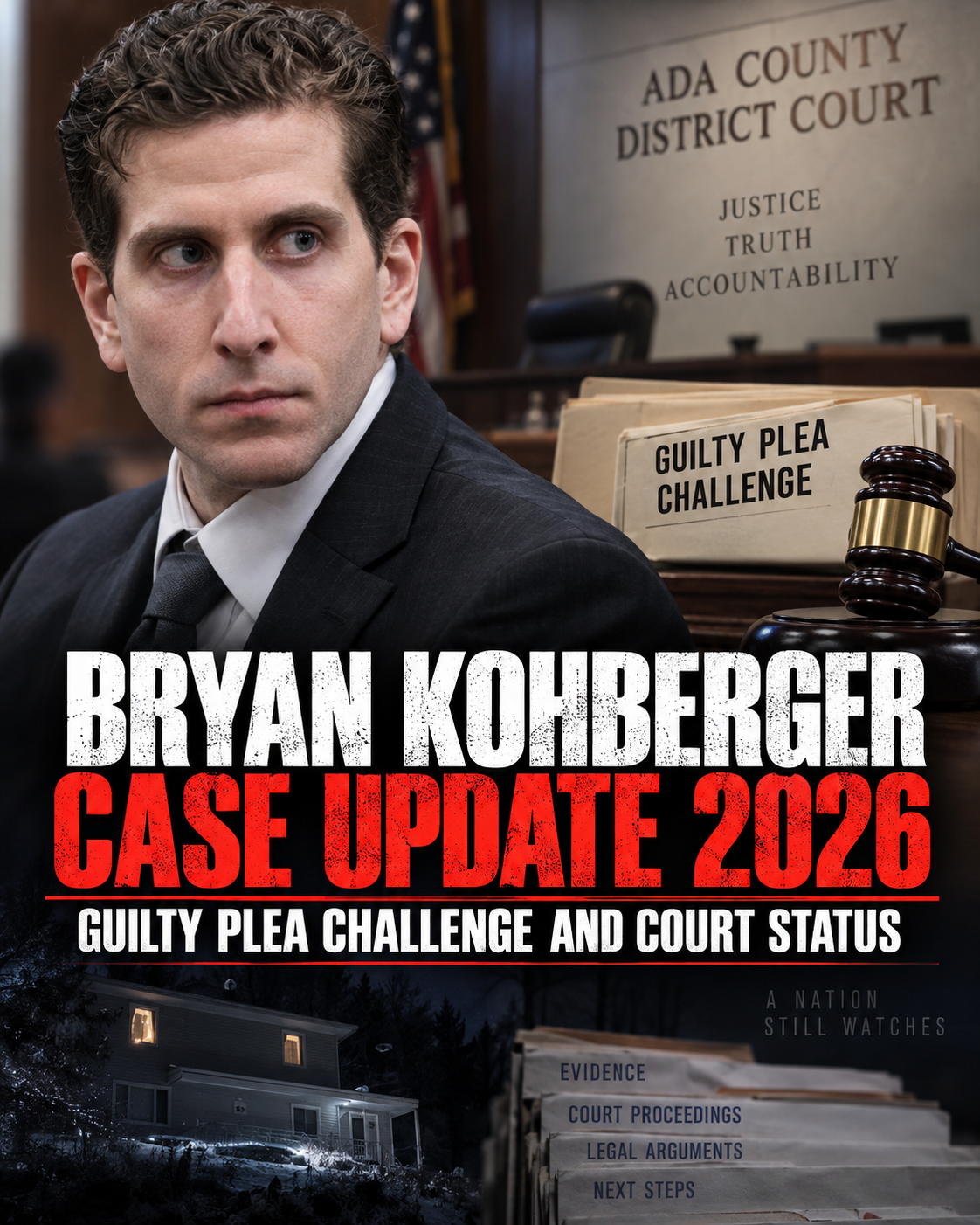
The Bryan Kohberger case update 2026 centers on a major legal development: the man who pleaded guilty to murdering four University of Idaho students is now attempting to withdraw his guilty plea through a post-conviction relief petition.
Bryan Kohberger pleaded guilty in July 2025 to four counts of first-degree murder and one count of felony burglary. On July 23, 2025, he received four consecutive life sentences without the possibility of parole, plus a fixed 10-year sentence for burglary. The plea agreement also removed the possibility of a death sentence.
Nearly a year later, Kohberger filed a petition challenging the circumstances surrounding his plea. He alleges that his former defense attorneys pressured him into admitting guilt, made promises that influenced his decision, and failed to adequately address potentially helpful evidence.
These are allegations made by Kohberger, not findings established by a court. Prosecutors have opposed his request for post-conviction relief.
As of October 27, 2026, his conviction has not been overturned, his sentences remain in effect, and the court has revised the schedule for the proceedings. The latest reported order gives him until January 13, 2027, to amend his petition and establishes additional deadlines for the parties to exchange evidence and expert disclosures. The court has not yet confirmed a new evidentiary hearing date.
This article examines the 2025 guilty plea, Kohberger’s life sentence, his 2026 petition, the claims against his former attorneys, his new legal representation, and what may happen next.
Bryan Kohberger Case Update 2026: What Happened?
The latest developments concern Kohberger’s attempt to challenge the legal process that resulted in his guilty plea and prison sentence.
In July 2026, he submitted a handwritten petition for post-conviction relief. In it, he alleged that his former attorneys had improperly influenced his decision to plead guilty and that potentially helpful evidence had not been adequately addressed.
The petition reopened a legal dispute over the circumstances of the plea, even though the original criminal prosecution had concluded in 2025.
The state has asked the court to reject the petition, arguing that Kohberger’s allegations are insufficiently supported and do not establish a legal basis for relief.
In October 2026, the court issued an amended scheduling order that changed the procedural timeline. The order did not overturn Kohberger’s conviction, grant his request to withdraw the plea, or determine that his allegations were true.
The central question remains whether he can establish legally sufficient grounds to challenge the plea he entered in July 2025.
Source: Associated Press — Updated timeline for Kohberger’s plea challenge.
What Happened in the Bryan Kohberger Case in July 2025?
The case reached a major turning point when Kohberger pleaded guilty shortly before the criminal trial was expected to begin.
July 2, 2025: Kohberger Pleads Guilty
Kohberger pleaded guilty to four counts of first-degree murder and one count of felony burglary.
The victims were University of Idaho students Madison Mogen, Kaylee Goncalves, Xana Kernodle, and Ethan Chapin, who were killed at an off-campus residence in Moscow, Idaho, on November 13, 2022.
The guilty plea avoided a full criminal trial. Under the agreement, prosecutors agreed not to pursue the death penalty.
By entering the plea, Kohberger admitted criminal responsibility for the four murders and burglary.
July 23, 2025: Four Consecutive Life Sentences
Judge Steven Hippler sentenced Kohberger to four consecutive life sentences without the possibility of parole. He also received a fixed 10-year sentence for burglary.
The term consecutive means that the four life sentences were imposed one after another rather than concurrently.
Because each murder conviction carried a life sentence without parole, Kohberger was ordered to remain imprisoned for the rest of his life, subject to any successful legal challenge to the judgment.
The sentencing concluded the original prosecution. The 2026 petition is a separate legal proceeding seeking to challenge the outcome.
Why Does Bryan Kohberger Want to Withdraw His Guilty Plea?
Kohberger’s July 2026 petition challenges the circumstances in which he accepted the plea agreement.
His claims focus on three main issues: the effectiveness of his former legal representation, alleged pressure or promises surrounding the plea, and the handling of potentially helpful evidence.
1. Alleged Pressure From His Former Defense Team
Kohberger has alleged that his former attorneys persuaded him to plead guilty through pressure, misinformation, and promises that influenced his decision.
His handwritten filing characterized his confession as false and claimed that he had been led to accept the plea despite maintaining that he was innocent.
These statements represent his position in the petition. They do not establish that his former attorneys acted improperly or that the plea was legally invalid.
2. Claims About the Death Penalty
The plea agreement removed the possibility of a death sentence in exchange for Kohberger’s guilty plea.
In his post-conviction filing, he alleges that his attorneys used the prospect of a death sentence and the expected conditions of death-row incarceration to influence his decision.
The death penalty was a significant consideration in the original plea negotiations. However, the existence of a difficult choice between a plea agreement and the possibility of a harsher sentence does not, by itself, establish unlawful coercion.
The court would need to evaluate the relevant evidence and applicable legal standards before determining whether the circumstances invalidate the plea.
3. Alleged Failure to Address Potentially Helpful Evidence
Kohberger has also claimed that his former defense team failed to disclose or adequately review evidence that could have helped his defense.
One issue raised in reporting on the petition concerns hair recovered at the crime scene that was not tested for DNA and was reportedly excluded as Kohberger’s through physical analysis.
The existence of an untested item does not automatically demonstrate that it would have changed the outcome of the case. Its relevance would depend on the evidence, the legal arguments, and the circumstances surrounding the plea.
Kohberger’s legal team may seek to develop these claims in an amended petition. The court has not determined that any alleged failure by the former defense team invalidated the guilty plea.
Source: Associated Press — Details of Kohberger’s post-conviction claims.
What Is Post-Conviction Relief, and How Could It Affect the Case?
Post-conviction relief is a legal procedure that allows a person convicted of a crime to challenge the legality of the conviction or sentence on qualifying grounds.
It is distinct from a conventional appeal. Depending on the jurisdiction and the claims raised, a post-conviction proceeding may examine constitutional issues, the effectiveness of legal representation, or whether a guilty plea was entered in accordance with the law.
Kohberger is using this process to challenge the circumstances of his plea.
What Must Kohberger Establish?
He must do more than express regret about the agreement or state that he now disputes his earlier admission.
His petition must satisfy the applicable legal requirements and provide a sufficient basis for the court to grant relief.
His claims include alleged ineffective assistance of counsel and assertions that the plea was not entered voluntarily. The court must assess whether those claims meet the relevant legal standards.
What Could Happen if His Petition Succeeds?
If the court ultimately grants relief sufficient to set aside his guilty plea and convictions, further criminal proceedings could follow. Depending on the court’s ruling, that could include renewed proceedings on the original charges.
Such an outcome would not automatically mean that Kohberger had been acquitted.
The legal consequences would depend on the precise ruling and any subsequent proceedings.
What Happens if the Petition Is Denied?
If the petition is dismissed or denied, his guilty plea and existing sentences would remain in effect, subject to any further legal remedies available to him.
As of October 27, 2026, no ruling has overturned the conviction.
Bryan Kohberger’s New Attorney in 2026
Kohberger has received new legal representation for his post-conviction proceedings.
Reports in 2026 identified Greg Rauch, an attorney based in Idaho, as his court-appointed lawyer. Private defense attorney Jason Goldman of New York was also reported to have joined the legal team.
The new representation is significant because the petition raises allegations about the performance of Kohberger’s former defense attorneys.
His current legal team may seek to amend the petition, provide supporting documentation, identify witnesses, and present arguments concerning whether the guilty plea was legally valid.
However, the appointment of new attorneys does not establish that his claims have merit. The court must independently assess the petition and the evidence presented by both sides.
Source: Fox 13 Seattle — Kohberger’s new legal team and plea challenge.
Why Are Prosecutors Opposing Kohberger’s Petition?
Prosecutors have asked the court to dismiss Kohberger’s petition rather than allow his challenge to proceed to an evidentiary hearing.
Their position is that the claims, as presented, do not establish a sufficient legal basis for post-conviction relief.
Prosecutors have also pointed to Kohberger’s statements during the original plea proceedings, when he acknowledged the agreement and affirmed that he was entering the plea knowingly and voluntarily.
Those earlier statements may be relevant to assessing his current allegations, but the court must determine their legal significance in the context of the petition.
The prosecution’s opposition does not itself decide the matter. The judge must evaluate the filings and applicable law before ruling on whether the case should proceed.
Source: Fox News — Prosecutors seek dismissal of Kohberger’s petition.
October 2026 Court Update: What Changed?
The court’s October scheduling order is especially important for readers looking for the Bryan Kohberger latest court update in 2026.
Earlier reports described a possible status conference in June 2027 and an evidentiary hearing tentatively scheduled for June 17, 2027. Those dates should no longer be described as confirmed hearing dates.
An amended order reported on October 14, 2026, removed previously scheduled hearings and established a revised timeline for the case.
The reported deadlines include:
- January 13, 2027: Deadline for Kohberger to amend his petition.
- April and May 2027: Deadlines for expert disclosures under the revised schedule.
- July 7, 2027: Reported deadline for completing evidence gathering.
- After other legal issues are addressed: The parties may need to contact the court to arrange a status conference and any possible evidentiary hearing.
The order did not decide the merits of Kohberger’s petition or establish that a full evidentiary hearing will definitely take place.
Source: KMVT — October 14, 2026, scheduling order update.
Bryan Kohberger’s Conviction Status in October 2026
As of October 27, 2026, Kohberger remains convicted of the four murders and burglary.
His four consecutive life sentences without the possibility of parole and additional 10-year burglary sentence remain in effect.
His post-conviction petition has not resulted in the withdrawal of his guilty plea, a new trial, or an overturning of the convictions.
It is important to distinguish between a pending legal challenge and a successful challenge. Filing a petition permits a defendant to seek relief under the relevant legal procedure, but it does not automatically suspend the judgment or change the sentence.
For now, the original judgment remains operative while the court addresses the procedural and substantive issues raised by the petition.
What Happens Next in the Bryan Kohberger Case?
The next phase will depend on the amended petition, the prosecution’s response, and the court’s decisions on outstanding legal issues.
Step 1: Amended Petition
Kohberger has until January 13, 2027, under the reported amended schedule to revise his petition.
The filing may provide additional details or supporting material for the allegations concerning his plea and former attorneys.
Step 2: Prosecution’s Response
The state will have an opportunity to respond to the amended petition under the applicable court schedule.
Prosecutors may continue arguing that the claims do not justify post-conviction relief.
Step 3: Evidence and Expert Disclosures
The revised schedule includes deadlines for the parties to disclose witnesses and expert opinions and complete evidence gathering.
These steps are intended to establish what evidence, if any, can properly be considered if the court allows further proceedings.
Step 4: Possible Status Conference or Evidentiary Hearing
The court has not confirmed a new evidentiary hearing date as of October 27, 2026.
A status conference may be arranged after the outstanding procedural issues are addressed. An evidentiary hearing would depend on whether the court determines that one is warranted.
A hearing would allow the court to consider relevant evidence on qualifying disputed issues. It would not automatically mean Kohberger’s guilty plea would be withdrawn.
Step 5: Court Decision
Ultimately, the judge will determine whether the petition meets the legal requirements for relief.
The outcome could affect whether the convictions remain in place or whether additional proceedings are necessary. Until the court issues a ruling, the result remains unresolved.
Frequently Asked Questions About the Bryan Kohberger Case Update 2026
Did Bryan Kohberger withdraw his guilty plea?
No. As of October 27, 2026, his guilty plea has not been withdrawn. He has filed a petition seeking post-conviction relief, but the court has not granted that request.
Why does Bryan Kohberger want to withdraw his guilty plea?
He alleges that his former attorneys pressured him into accepting the plea, made promises that influenced his decision, and failed to adequately address potentially helpful evidence. These allegations have not been established as fact by the court.
Is Bryan Kohberger still serving life sentences?
Yes. His four consecutive life sentences without parole, along with the fixed 10-year burglary sentence, remain in effect while the post-conviction proceedings continue.
Who is Bryan Kohberger’s new attorney?
Reports in 2026 identified Greg Rauch as his court-appointed attorney and Jason Goldman as an additional private defense lawyer.
Has a new hearing been confirmed for 2027?
No new evidentiary hearing date had been confirmed as of October 27, 2026. Earlier June 2027 dates were affected by the October scheduling order, which established new deadlines and removed previously scheduled hearings.
Could Bryan Kohberger face the death penalty again?
The original plea agreement removed the possibility of a death sentence. If a court were to set aside the plea and the case returned to further proceedings, the consequences would depend on the precise ruling, the status of the charges, and the applicable law. The possibility should not be described as a certainty.
Has a judge ruled that Kohberger’s lawyers acted improperly?
No such finding has been established in the proceedings covered by the October 2026 update. The claims concerning his former attorneys remain allegations that must be assessed through the legal process.
When is the next Bryan Kohberger court hearing?
As of October 27, 2026, no new evidentiary hearing date had been confirmed. The immediate reported deadline is January 13, 2027, for Kohberger to amend his petition.
Conclusion
The Bryan Kohberger case update for 2026 is focused on his attempt to challenge the guilty plea that resulted in four consecutive life sentences.
Kohberger pleaded guilty in July 2025 to the murders of Madison Mogen, Kaylee Goncalves, Xana Kernodle, and Ethan Chapin. He was sentenced later that month, avoiding a trial and the possibility of a death sentence under the plea agreement.
In July 2026, he filed a post-conviction petition alleging that his former defense attorneys improperly influenced his decision and failed to address potentially helpful evidence. Prosecutors have opposed the petition, and the court has not overturned the conviction.
The October 2026 scheduling order changed the timeline for the proceedings, including the deadline for an amended petition and the arrangements for any future hearing.
The central legal question is whether Kohberger can establish a valid basis to withdraw his guilty plea. Until the court decides that question, his conviction and sentences remain in effect.
For readers following the case, the most important distinction is between Kohberger’s allegations, the prosecution’s response, and the court’s eventual findings. The next developments will depend on the filings and rulings in the post-conviction proceedings.