The cryptocurrency industry is facing one of the biggest security crises in its history after Binance reported a massive security incident involving approximately $6.3 billion in digital assets. The attack, which occurred on October 29, 2026, targeted Binance’s cryptocurrency wallet infrastructure and raised serious questions about the security of even the world’s largest crypto exchanges.
According to blockchain security researchers, the attackers managed to move billions of dollars across multiple blockchain networks, with most of the funds transferred in approximately 20 minutes.
The incident has also drawn attention to TraderTraitor, a North Korean-linked hacking group suspected by several blockchain intelligence companies of carrying out the attack.
But how did hackers manage to access such a massive amount of cryptocurrency? Was a Binance employee involved? And are customer funds still safe?
Here is everything you need to know about the Binance $6.3 billion hack, how the attack reportedly happened, and what it means for cryptocurrency users.
What Happened in the Binance $6.3 Billion Hack?
On October 29, 2026, Binance experienced a major security incident that resulted in approximately $6.3 billion in cryptocurrency being affected.
The incident involved Binance wallet infrastructure, with attackers reportedly gaining unauthorized access to systems responsible for processing cryptocurrency withdrawals.
Binance initially suspected that a DevOps engineer’s compromised laptop may have provided attackers with access to a service container. However, further investigation uncovered additional points of breach, suggesting that the incident was more complicated than initially believed.
According to blockchain intelligence firm TRM Labs, approximately $6.36 billion in cryptocurrency was moved from Binance wallets across ten different blockchain networks.
Most of the transactions reportedly took place within around 20 minutes.
Binance confirmed that it was working with blockchain partners and law enforcement agencies to investigate the incident and recover affected assets.
The company also stated that it would cover all losses using its SAFU fund and company resources.
How Did Hackers Steal $6.3 Billion From Binance?
Understanding how the Binance hack happened requires looking beyond traditional cryptocurrency theft.
The attack reportedly involved a combination of compromised internal access, unauthorized transaction approvals, and sophisticated blockchain techniques.
Here is how the attack is believed to have unfolded.
1. Hackers May Have Compromised an Employee’s Laptop
Binance’s initial investigation suggested that attackers may have gained access through a compromised laptop belonging to a DevOps engineer.
DevOps employees often work with the systems responsible for maintaining software, infrastructure, and internal services.
If attackers compromise a device with access to sensitive internal systems, they may be able to move deeper into an organization’s network.
In this incident, Binance said the compromised laptop may have allowed an attacker to access a service container and submit unauthorized withdrawal transactions.
However, the exchange later confirmed that investigators had discovered additional breach points.
This means the laptop theory alone does not explain the entire attack.
2. Attackers Targeted the Wallet Transaction Infrastructure
Cryptocurrency exchanges use hot wallets to process deposits and withdrawals.
These wallets remain connected to online systems, allowing exchanges to transfer cryptocurrency quickly when customers request withdrawals.
However, hot wallets also create security risks because their transaction systems must remain accessible to authorized services.
According to blockchain intelligence researchers, the Binance attackers appear to have compromised the infrastructure responsible for authorizing wallet transactions.
This is particularly important because gaining control over transaction authorization can potentially allow attackers to move cryptocurrency without directly stealing private keys.
Binance stated that its investigation had found no evidence of wallet private key leakage.
The exact technical root cause has not yet been fully established in the company’s investigation.
3. Hackers Used Sophisticated Blockchain Transactions
One of the most interesting technical details involves Ethereum’s EIP-7702 functionality.
According to TRM Labs, attackers used an EIP-7702 delegation mechanism to give attacker-controlled code control over a Binance hot wallet on Ethereum.
This feature allows an externally owned Ethereum account to temporarily execute smart contract logic through delegation.
In simple terms, the attackers reportedly manipulated the wallet’s transaction behavior to transfer cryptocurrency to addresses they controlled.
Researchers also reported that wallets on other blockchain networks processed unauthorized transfers through signed transactions.
This suggests that the attack involved more than a single compromised wallet.
It potentially affected the broader transaction-signing infrastructure used across multiple networks.
4. Billions of Dollars Were Transferred in Approximately 20 Minutes
Speed played a major role in the attack.
According to TRM Labs, the majority of the stolen cryptocurrency was transferred within approximately 20 minutes.
The transactions involved multiple blockchain networks, including:
- Ethereum
- Bitcoin
- Tron
- Solana
- XRP Ledger
- Avalanche
- Polygon
Moving cryptocurrency across multiple networks makes investigations more complicated because each blockchain has its own transaction history and infrastructure.
The attackers reportedly distributed funds across numerous addresses to make tracking and recovery more difficult.
Blockchain investigators immediately began monitoring these transactions to identify suspicious movements and prevent additional losses.
Is North Korea Behind the Binance Hack?
One of the biggest questions surrounding the Binance security incident is the identity of the attackers.
Several blockchain intelligence companies have linked the attack to North Korean cybercriminal operations.
TRM Labs and Chainalysis have both pointed toward a group known as TraderTraitor.
TRM Labs described its attribution as high confidence, based on its analysis of on-chain and off-chain intelligence.
However, Binance has not officially confirmed the identity of the attackers. The investigation remains ongoing.
Who Is the TraderTraitor Hacking Group?
TraderTraitor is a North Korea-linked cyber threat group associated with sophisticated cryptocurrency theft operations.
The group has been connected to multiple major attacks targeting cryptocurrency exchanges, blockchain companies, and digital asset platforms.
Its methods reportedly include:
- Social engineering attacks.
- Targeting employees of cryptocurrency companies.
- Compromising internal systems.
- Stealing access credentials.
- Manipulating cryptocurrency transaction processes.
- Moving stolen assets across multiple blockchain networks.
The group gained significant attention following the February 2025 Bybit hack, in which approximately $1.5 billion in cryptocurrency was stolen.
The FBI attributed that attack to North Korean cyber actors associated with TraderTraitor.
Researchers have identified similarities between the Bybit and Binance incidents, although attribution of the Binance attack remains an investigative conclusion rather than an officially confirmed finding.
How Did Hackers Move the Stolen Cryptocurrency?
Stealing cryptocurrency is only part of a major cyberattack. Attackers also need to move the assets without allowing investigators to identify or freeze them.
In the Binance incident, blockchain researchers reported several techniques that made the movement of funds particularly complicated.
Using Multiple Wallet Addresses
The attackers reportedly distributed cryptocurrency across different wallet addresses and blockchain networks.
This creates a complicated transaction trail for investigators.
However, cryptocurrency transactions remain publicly visible on most major blockchains, allowing researchers to follow funds between addresses.
Using Crypto Mixers
Blockchain investigators also identified links to Tornado Cash, a cryptocurrency mixing service.
Crypto mixers are designed to make it more difficult to connect incoming and outgoing transactions.
According to researchers, the attacker’s operational wallet received small amounts of cryptocurrency through Tornado Cash before the main incident.
These transactions were reportedly part of the preparation process.
Converting Stablecoins Into Other Cryptocurrencies
Another challenge involved the conversion of stolen assets.
Stablecoins such as USDT and USDC can be frozen by their issuers when suspicious activity is identified.
This gives stablecoin companies an important role in responding to major cryptocurrency thefts.
Researchers reported that several issuers and blockchain partners froze billions of dollars in affected assets.
How Much Money Was Recovered After the Binance Hack?
One of the most important developments following the Binance incident was the effort to freeze affected cryptocurrency.
Binance reported that approximately $3 billion in affected assets had been frozen through cooperation with blockchain partners.
Stablecoin issuers also played an important role in preventing additional movement of certain stolen assets.
Companies including Tether and Circle reportedly froze substantial amounts of USDT and USDC connected to the incident.
However, not every cryptocurrency can be frozen in the same way.
Bitcoin and Ether, for example, cannot simply be frozen by a centralized token issuer.
Their recovery generally depends on tracing the funds and identifying exchanges or other services that may be able to intervene.
The final amount recovered remains subject to ongoing investigation.
Are Binance Customer Funds Safe After the $6.3 Billion Hack?
Following the incident, Binance stated that customer funds were safe and that the company would cover all losses.
The exchange said it would use its Secure Asset Fund for Users (SAFU) and company resources to address the financial impact.
SAFU is Binance’s emergency reserve designed to help protect users in extreme situations.
The exchange also temporarily suspended deposits and withdrawals as a precaution while security checks were completed.
For cryptocurrency users, this incident highlights an important point: even large and established exchanges can experience serious security problems.
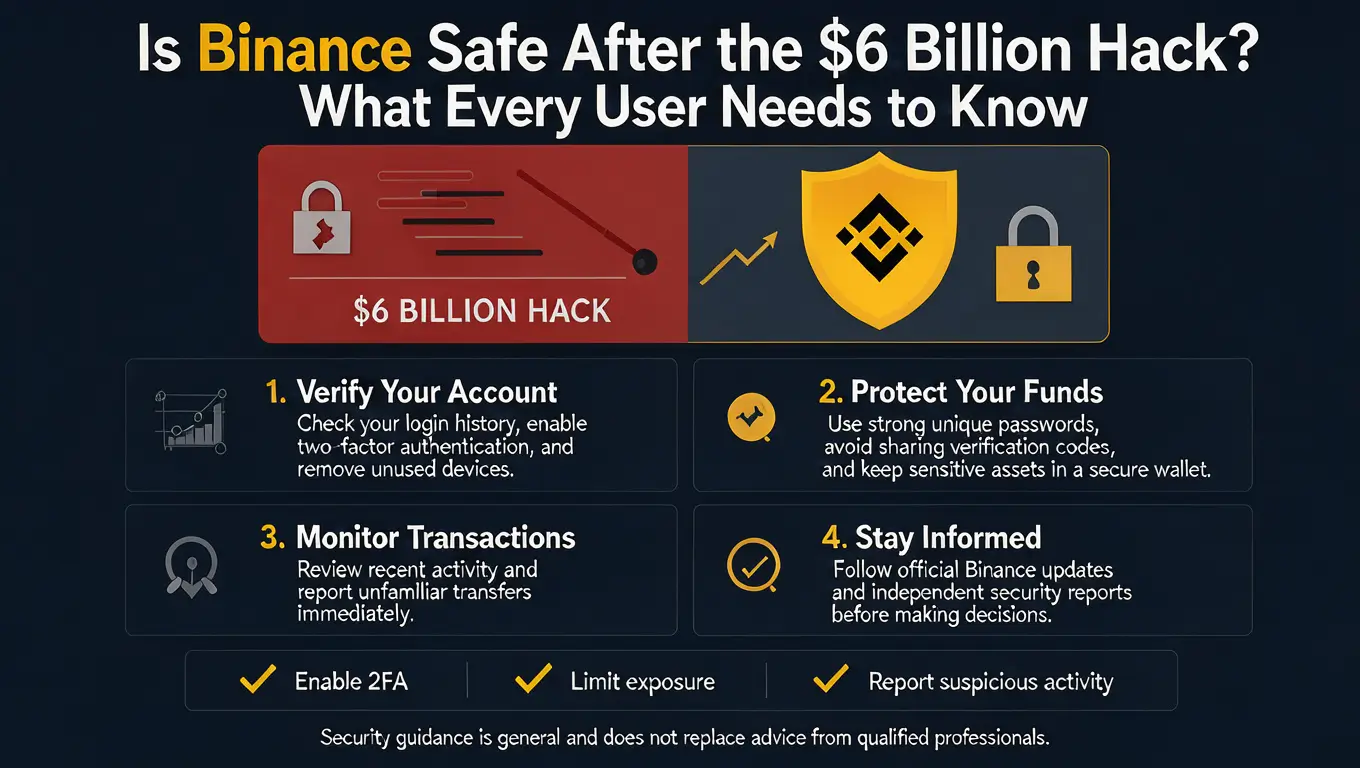
Users should consider taking additional precautions, including:
- Enable two-factor authentication (2FA).
- Use unique passwords for exchange accounts.
- Avoid suspicious emails and links.
- Never share account verification codes.
- Activate withdrawal address whitelisting where available.
- Monitor account activity regularly.
- Consider secure self-custody for long-term cryptocurrency holdings.
It is also important to follow official Binance announcements instead of relying on unverified social media posts.
How Does the Binance Hack Compare With the Bybit Hack?
The Binance incident is particularly significant because of its reported financial impact.
For comparison, Bybit experienced a major cryptocurrency theft in February 2025, involving approximately $1.5 billion.
The FBI attributed that attack to North Korean cyber actors associated with TraderTraitor.
The Binance incident has a substantially higher reported impact, making it one of the largest cryptocurrency thefts ever reported.
Both incidents also raise concerns about the security of internal systems and the processes used to authorize cryptocurrency transactions.
The comparison shows why cryptocurrency companies need stronger employee security, transaction monitoring, and independent authorization systems.
What Does the Binance Hack Mean for the Future of Cryptocurrency Security?
The Binance incident could have significant consequences for the wider cryptocurrency industry.
First, exchanges may need to strengthen internal security systems and review how employees access sensitive infrastructure.
Second, transaction authorization systems may require additional independent verification before large transfers are approved.
Third, blockchain analytics companies and cryptocurrency issuers will likely face greater pressure to improve their ability to identify and freeze suspicious assets.
Finally, investors may become more cautious about keeping large amounts of cryptocurrency on centralized exchanges.
The incident also demonstrates that cybersecurity is not simply about protecting private keys. Internal access, employee devices, software infrastructure, and transaction authorization systems can all become potential targets.
As cryptocurrency adoption continues to grow, exchanges will need to invest more heavily in security infrastructure and real-time threat detection.
Frequently Asked Questions (FAQs)
1. How much money was stolen in the Binance hack?
Binance reported an estimated financial impact of approximately $6.3 billion following its October 29, 2026 security incident. Blockchain intelligence firms estimated the amount at approximately $6.36 billion.
2. How did Binance get hacked?
Binance’s initial investigation suggested that a compromised DevOps engineer’s laptop may have provided attackers with access to internal systems. Further investigation uncovered additional breach points. Blockchain researchers believe the attackers compromised transaction-signing infrastructure to authorize unauthorized cryptocurrency transfers.
3. Is North Korea responsible for the Binance hack?
Blockchain intelligence companies TRM Labs and Chainalysis have linked the incident to North Korea’s TraderTraitor hacking group. However, Binance has not officially confirmed the attackers’ identity.
4. What is the TraderTraitor hacking group?
TraderTraitor is a North Korea-linked cyber threat group associated with major cryptocurrency thefts, including the 2025 Bybit hack. It reportedly uses social engineering and sophisticated technical methods to target cryptocurrency companies.
5. Did Binance lose customer funds?
Binance stated that customer funds were safe and that it would cover all losses using its SAFU fund and company resources.
6. How much cryptocurrency was frozen after the attack?
Binance reported that approximately $3 billion in affected assets had been frozen through cooperation with blockchain partners. The final recovery amount may change as investigations continue.
7. Was the Binance hack bigger than the Bybit hack?
Yes. The Binance incident’s estimated impact of approximately $6.3 billion is significantly higher than the approximately $1.5 billion stolen in the 2025 Bybit incident.
8. Can Binance users still withdraw their cryptocurrency?
Binance temporarily suspended deposits and withdrawals as a security precaution. Users should check the exchange’s official announcements for the latest withdrawal status.
Final Thoughts
The Binance $6.3 billion hack is a major reminder that cryptocurrency security remains a serious challenge, even for the world’s largest exchanges.
The incident reportedly involved compromised internal access, unauthorized transaction approvals, and sophisticated blockchain techniques.
Although blockchain intelligence companies have linked the attack to North Korea’s TraderTraitor group, the investigation is still ongoing.
Binance has promised to cover all losses and is working with blockchain partners and law enforcement agencies to investigate the incident.
For cryptocurrency investors, the biggest lesson is clear: security should always be a priority, regardless of how large or established an exchange may be.
Disclaimer: This article is for informational and educational purposes only. The Binance security incident remains under investigation, and some technical details and attacker attribution are based on preliminary findings from blockchain intelligence companies. Always consult official announcements for verified updates.